



 How To Win
- The first issued card determines the dealing sequence for Banker, Player 1, Player 2 and Player 3. A player can bet on Player1 – 3 and Banker (wins Player) 1-3 odd of equal or double.
- If betting on Player 1, Player 2 or Player 3 and the corresponding Player’s total point is larger than Banker’s total point then the Player win. Or if betting on Banker (wins Player) 1,2 or 3 and Banker’s total point is larger than the corresponding Player’s total point then the Player win.
- For odds of equal and odd of double, please refer to “Explanation” section.
- Equal: the payout is fixed and does not depend on the winning card type.
Participation Instructions and Bet Options
1
Dealer shows the “First Card” when each game round starts. The first card drawn established the order in which the cards will be dealt.
2
Select the amount you would like to wager and dragging it on the betting area (Player 1/2/3 ‘Equal’ /’Double’ / ’Many’ or Banker 1/2/3‘Equal’/ ‘Double’ / ’Many’)
3
Once all bets are placed the cards are dealt per the dealing sequence. Cards are laid out from the dealer’s right to left.
4
When all the cards have been dealt the hands are compared with the banker’s hand to determine the outcome.
Game Instructions
- The game is played with one standard card deck (52 card excluding Joker). After 5 cards are dealt to each hand, the cards are arranged in the best possible way into a set of 3 cards that are added up to a multiple of 10 and a set of the 2 remaining cards. The hand ranking is depending on the value of the set of 3 cards and 2 card. You have several bet types you can choose:
| Player 1 : Equal, Double, Many | 'Banker 1': Equal, Double, Many (remark: Banker win Player 1) |
| Player 2 : Equal, Double, Many | 'Banker 2': Equal, Double, Many (remark: Banker win Player 2) |
| Player 3 : Equal, Double, Many | 'Banker 3': Equal, Double, Many (remark: Banker win Player 3) |
Dealing Sequence In Counter Clockwise Direction
- First Card: Dealer shows the “First Card” when each game round starts. The rank of the First Card decides the dealing sequence.
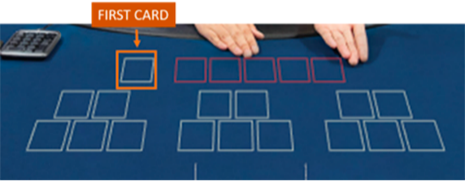
- The “First Card” value (A=1 point, 2 to K = 2 to 13 points), is divided by 4 and keep the decimal value.
| A,5,9,K | Banker > Player 1 > Player 2 > 3 |
| 2,6,10 | Player 1 > Player 2 > Player 3 > Banker |
| 3,7,J | Player 2 > Player 3 > Banker > Player 1 |
| 4,8,Q | Player 3 > Banker > Player 1 > Player 2 |
Note: Follow the sequence above. Dealing 5 cards to each Player including the Banker.
During the game, if the points are the same, players need to choose the highest ranking card from the 5 cards to compare. The player who has the highest ranking card wins if the points and rank are the same, players need to compare the suit. Please see the table below:
Card Types
| Types | Illustration | Explanation |
|---|---|---|
5 Gongs (5,J,Q,K) |
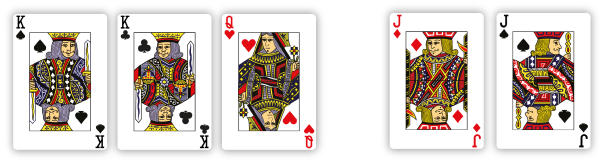 |
5 cards consist of J,Q,K |
Bull Bull |
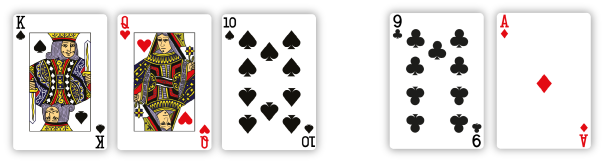 |
3 cards add up to a multiple of 10.The rest of 2 cards add up to 10 or 20 |
| Bull 9 | 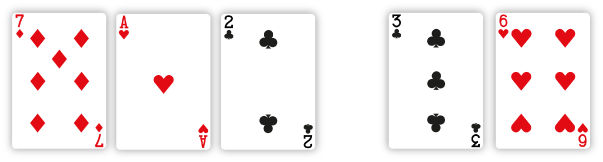 |
3 cards add up to a multiple of 10.The rest of 2 cards add up to 9 or 19 |
Bull 8 |
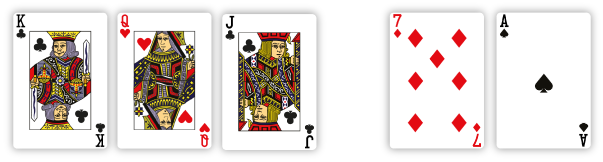 |
3 cards add up to a multiple of 10.The rest of 2 cards add up to 8 or 18 |
Bull 7 |
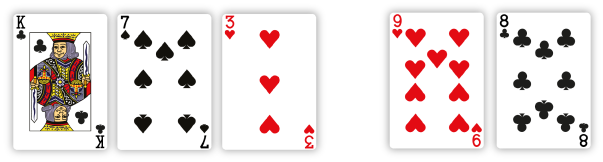 |
3 cards add up to a multiple of 10.The rest of 2 cards add up to 7 or 17 |
Bull 6 |
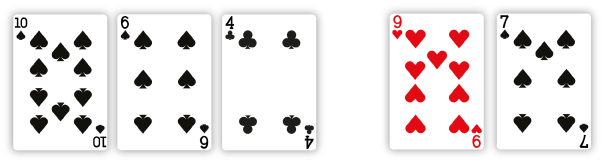 |
3 cards add up to a multiple of 10.The rest of 2 cards add up to 6 or 16 |
Bull 5 |
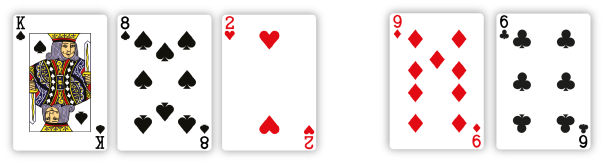 |
3 cards add up to a multiple of 10.The rest of 2 cards add up to 5 or 15 |
Bull 4 |
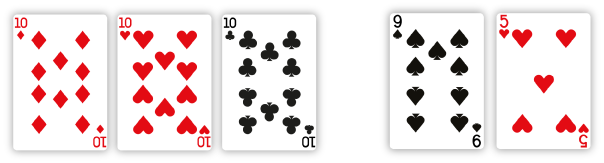 |
3 cards add up to a multiple of 10.The rest of 2 cards add up to 4 or 14 |
Bull 3 |
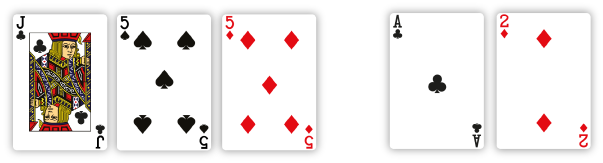 |
3 cards add up to a multiple of 10.The rest of 2 cards add up to 3 or 13 |
Bull 2 |
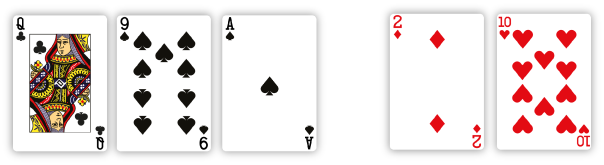 |
3 cards add up to a multiple of 10.The rest of 2 cards add up to 2 or 12 |
Bull 1 |
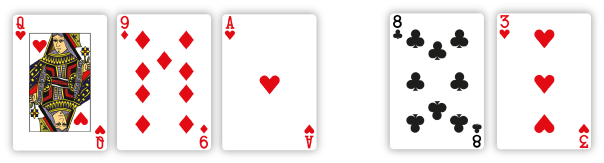 |
3 cards add up to a multiple of 10.The rest of 2 cards add up to 1 or 11 |
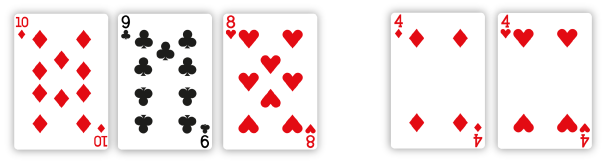
No Bull |
|
3 cards cannot add up to a multiple of 10.For example 4, 10, 9, 4, 8. |
Large / Small
| Card Types | Explanation |
|---|---|
| Points: | J, Q, K equals 10.Other cards shall carry their denoted numerical value. Ace equals 1. |
| 5P (5J,Q,K) > Bull Bull > Bull9 > Bull8 > Bull7 > Bull6 > Bull5 > Bull4 > Bull3 > Bull2 > Bull1 > None | |
| Rank | K > Q > J > 10 > 9 > 8 > 7 > 6 > 5 > 4 > 3 > 2 > A |
| Suit | Spades (♠) > Hearts(♥) > Clubs (♣) > Diamonds (♦) |
Player (Banker) Odds Of Win
| Card Types | Odds Of Equal | Odds Of Double | Odds Of Many |
|---|---|---|---|
| 5P | 1:0.95 | 1:4.75 | 1:10.45 |
| Bull Bull | 1:0.95 | 1:2.85 | 1:9.50 |
| Bull 9 | 1:0.95 | 1:1.90 | 1:8.55 |
| Bull 8 | 1:0.95 | 1:1.90 | 1:7.60 |
| Bull 7 | 1:0.95 | 1:1.90 | 1:6.65 |
| Bull 6 | 1:0.95 | 1:0.95 | 1:5.7 |
| Bull 5 | 1:0.95 | 1:0.95 | 1:4.75 |
| Bull 4 | 1:0.95 | 1:0.95 | 1:3.8 |
| Bull 3 | 1:0.95 | 1:0.95 | 1:2.85 |
| Bull 2 | 1:0.95 | 1:0.95 | 1:1.9 |
| Bull 1 | 1:0.95 | 1:0.95 | 1:0.95 |
| No Bull | 1:0.95 | 1:0.95 | 1:0.95 |
Player (Banker) Odds Of Lose
| Card Types | Odds Of Equal | Odds Of Double | Odds Of Many |
|---|---|---|---|
| 5P | 1:1 | 1:5 | 1:11 |
| Bull Bull | 1:1 | 1:3 | 1:10 |
| Bull 9 | 1:1 | 1:2 | 1:9 |
| Bull 8 | 1:1 | 1:2 | 1:8 |
| Bull 7 | 1:1 | 1:2 | 1:7 |
| Bull 6 | 1:1 | 1:1 | 1:6 |
| Bull 5 | 1:1 | 1:1 | 1:5 |
| Bull 4 | 1:1 | 1:1 | 1:4 |
| Bull 3 | 1:1 | 1:1 | 1:3 |
| Bull 2 | 1:1 | 1:1 | 1:2 |
| Bull 1 | 1:1 | 1:1 | 1:1 |
| No Bull | 1:1 | 1:1 | 1:1 |
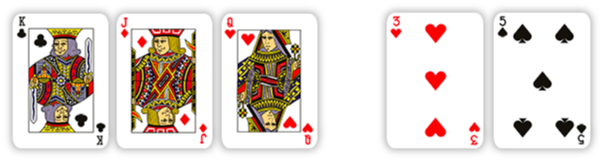
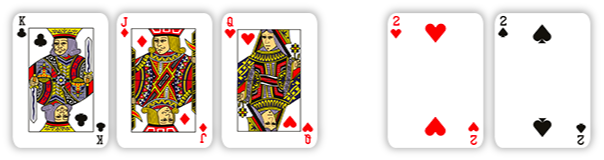
|
|
Explanation
| Explanation 2 | |
|---|---|
| Condition | Bet 200 on “Many” under Player 3 |
| Credit | Deduct 2200 points |
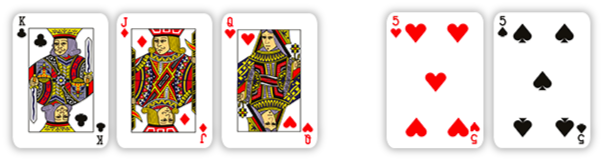
| Result |
Banker : Bull 4
Player 3 : Bull Bull
|
| Payoff | Win 6 points, win 5.7 Multiple. Return 2200 Payoff : 1,140 Points |
Attention
- Table bet limits are the main game table smallest and largest bet amounts. Players may bet on each bet type within the table and the player’s personal limits.
- In case of incorrect settlement, bets will be re-settled based on the current video result.

Back to Top